
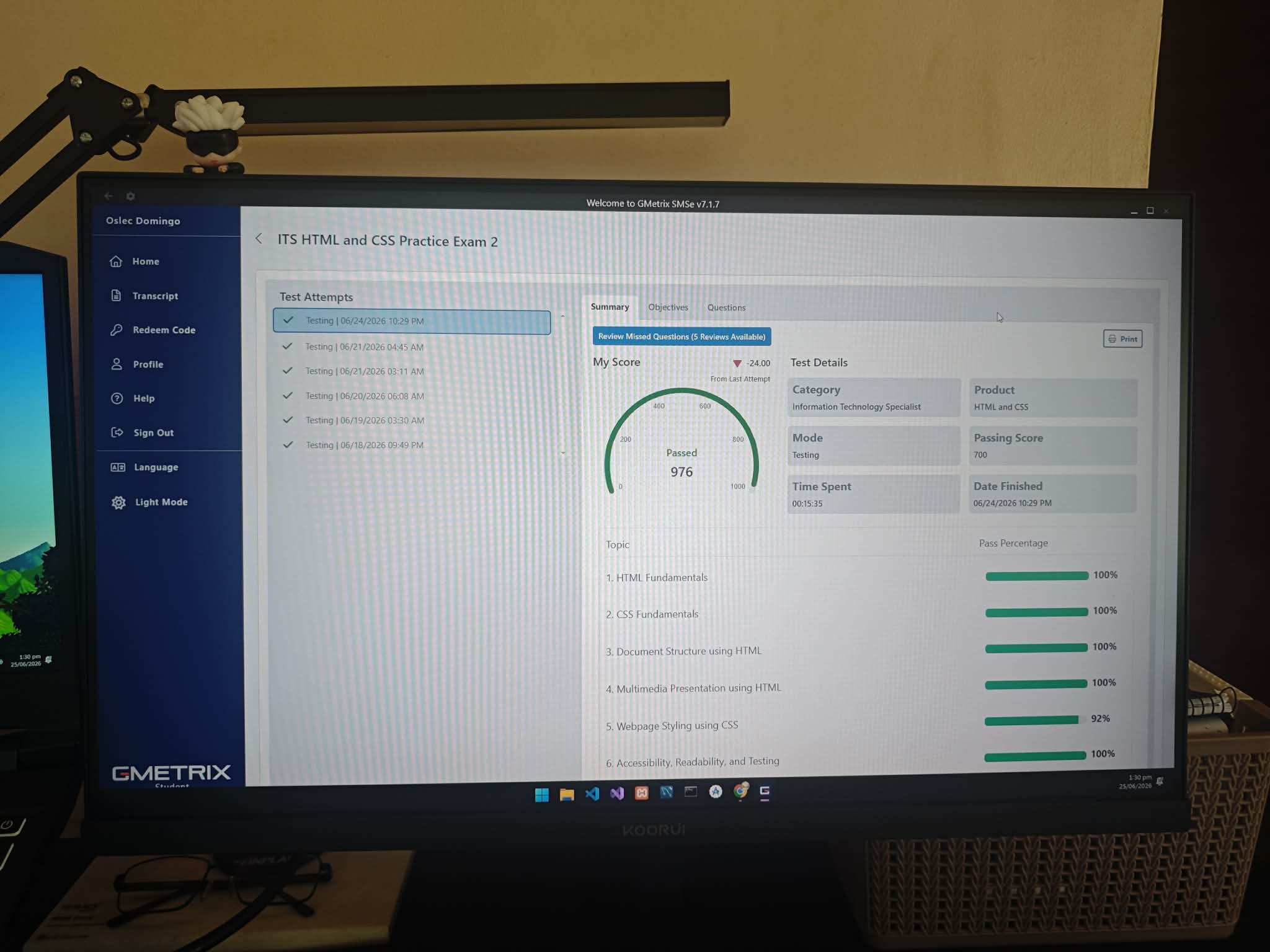
Today’s review session was completely locked into the official IT Specialist HTML and CSS exam objectives, and it felt great to systematically run through the exact topics the certification tests. Instead of just coding freely, I structured my study time around the core domain areas, beginning with HTML Fundamentals and Document Structure. I drilled down into constructing well-formed page markup, making sure I have the exact syntax rules down for the <!DOCTYPE html> declaration and the strict pairing of tags. A big chunk of time went into memorizing the specific behaviors of HTML5 semantic elements like <main>, <article>, <section>, and <aside>. Because the ITS exam loves to test structural integrity, I also practiced analyzing nested block-level versus inline elements, table tags (<tr>, <th>, <td>), and form controls—paying close attention to attributes like action, method, and input restrictions.
The second half of the session was a massive drill on CSS Fundamentals and Webpage Styling. I forced myself to review the rules of cascading and specificity weights (inline vs. internal vs. external stylesheets) because tracking style precedence is a classic exam trap. I also spent a good amount of time reviewing the exact mechanics of the CSS box model, making sure I can mentally calculate total element width and height when padding, margins, and borders are thrown into the equation. From there, I practiced positioning rules—specifically how absolute, relative, fixed, and static properties affect document flow—alongside basic responsive layouts using media queries and viewport units like vw and vh.
To wrap things up, I dedicated the final hour to Domain 6: Accessibility, Readability, and Testing. I reviewed W3C industry best practices, text alternatives using the alt attribute for images, and checking semantic hierarchies for screen readers. It’s one thing to make a page look pretty, but the ITS exam expects you to catch syntax errors, mismatched tags, and broken cascading logic on the spot. Breaking down the material by the actual testing domains makes the exam feel a lot less intimidating, and I’m feeling much more confident about handling the multiple-choice scenario questions.